French silent letters are not random — they follow patterns that, once you understand them, make the language much more predictable to read and pronounce. This guide breaks down exactly which letters are silent, why they exist and when they come back to life in connected speech. If you are also building your core vocabulary, the common French words guide is a useful companion — many of the highest-frequency words in French are also the ones where silent letters cause the most confusion. When you want to practise pronouncing these words and phrases aloud, try pronunciation practice and guided conversations with Kippy.
What Are Silent Letters in French?
A silent letter is a letter that appears in the written form of a word but is not pronounced when speaking. In English this happens occasionally — the K in knife, the W in write — but in French it is the norm rather than the exception. A large proportion of written French consonants, particularly at the ends of words, are completely absent from the spoken form. This gap between spelling and pronunciation is one of the defining features of the French language and one of the first real challenges for learners.
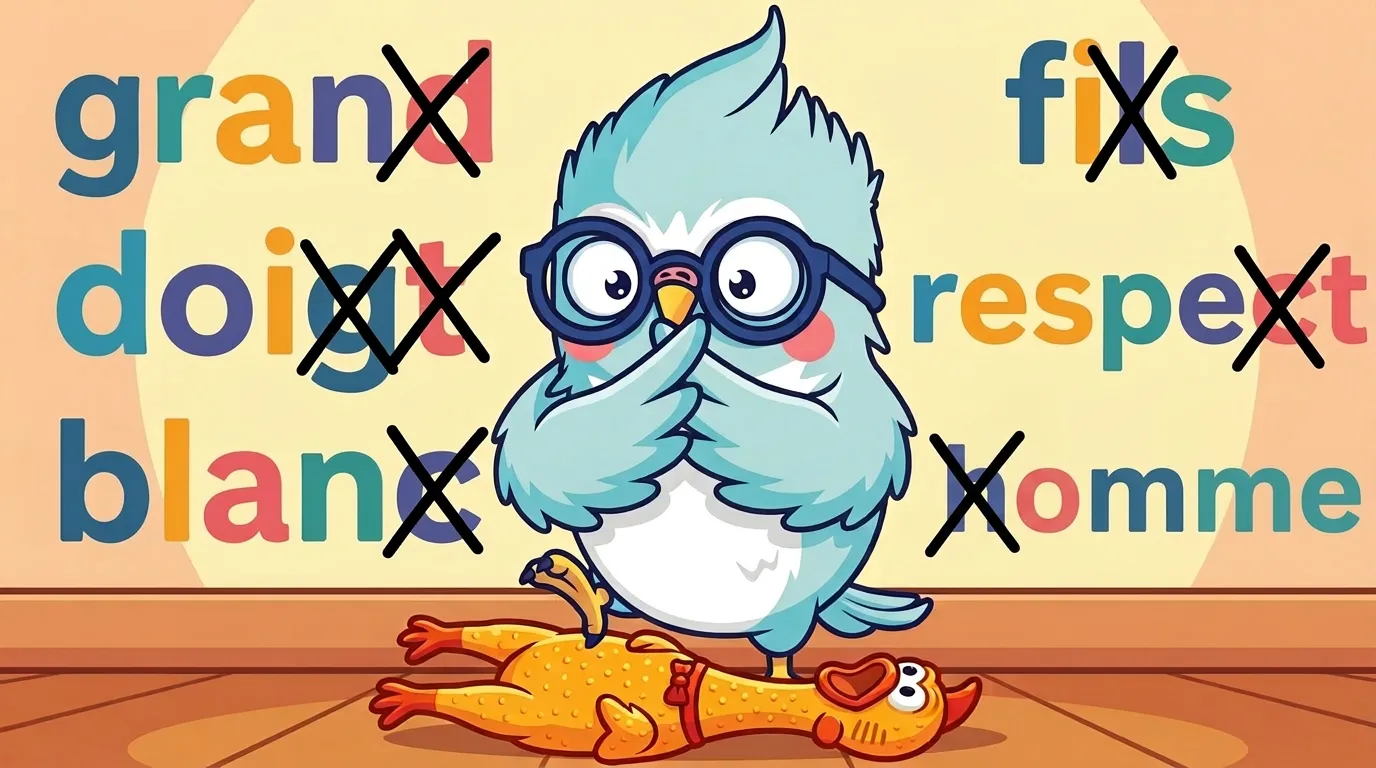
Take the word grand — in written French it ends in a D, but in speech it sounds like:
grahn — the D is silent
Or temps (time), which is spelled with both a P and an S at the end, neither of which you pronounce:
tahn — both the P and S are silent
Understanding this disconnect early on saves a huge amount of confusion when moving between reading and listening in French.
Why Does French Have So Many Silent Letters?
Silent letters in French are not accidental — they are the result of several forces acting on the language over centuries. Understanding why they exist helps learners stop treating them as arbitrary and start seeing the underlying logic.
Historical Pronunciation
The most significant reason is that many letters were once fully pronounced but gradually fell silent as the spoken language evolved. French spelling was largely standardised centuries ago and has changed far less than pronunciation since then. The written form preserves a kind of historical snapshot of how the language sounded in an earlier era, while the spoken form has moved on.
tahn — the P was once pronounced in Old French
Grammatical Markers
Some silent letters exist specifically to mark grammatical information — plural forms, verb conjugations, gender agreements — that is visible in writing but absent in speech. This is why spoken French can be harder to follow for learners who have primarily studied from text: many grammatical distinctions that look different on the page sound identical when spoken. If you want to sharpen your grasp of these written grammar patterns, the grammar checker tool helps you spot and understand them in context.
eel parl — the -ent ending that marks third person plural is completely silent
Word Families
Silent letters also frequently appear to visually link words within the same family, even when the sound has been dropped in one of them. This is actually useful once you are aware of it — the silent letter in one form often points you toward a related word where that letter is pronounced.
puh-tee — the T is silent in the masculine form
puh-teet — the T is pronounced in the feminine form because the E that follows activates it
This pattern — a silent consonant in one form that becomes audible in a related form — repeats across hundreds of French words.
Common Silent Letters in French
While silent letters appear throughout French words, most of them cluster at the ends of words. The consonants most frequently silent are T, S, D, P, X and Z. Learning to automatically suppress these at the end of a word gets you most of the way to natural French pronunciation.
The CaReFuL Rule
A widely used guide for final consonants is the CaReFuL rule: the letters C, R, F and L are generally pronounced at the end of French words, while most other final consonants are silent.
This rule is a starting point, not an absolute law — there are exceptions in both directions — but it covers the majority of cases and gives learners a reliable default when they encounter an unfamiliar word.
Silent Letters at the End of Words
The end of a word is where silent letters are most concentrated in French. The consonants T, S, D and P are silent in the vast majority of final positions, which means that many French words sound shorter than they look when written.
sha — the T is silent
frwah — the D is silent
troh — the P is silent
voo — the S is silent
This shortening of word endings is one of the reasons French can sound so fluid and fast to learners — there are simply fewer sounds per word than the spelling suggests.
Silent Letters in Plural Forms
French plural endings are almost always silent, which means that singular and plural forms of most nouns sound identical when spoken. The only signal that a word is plural in spoken French often comes from the article or surrounding context rather than the noun itself.
sha
sha — pronunciation is identical
The same applies to most verb endings. The written forms je parle, tu parles and ils parlent all look different on the page but are pronounced the same way in everyday speech. This is why learners who focus heavily on writing can be caught off guard when listening — the plurals and conjugation markers they have learned to look for visually simply do not appear as sounds.
eel parl — the -ent is silent
Silent Letters and French Liaison
Liaison is the rule in French where a normally silent final consonant becomes pronounced when the following word begins with a vowel or a mute H. This is one of the most important concepts for learners to understand, because it means a letter that is completely absent in one context suddenly reappears in another.
The S in les is silent when it stands alone before a consonant:
lay leevr — the S is silent before a consonant
But before a vowel, that S is pronounced as a Z sound, linking the two words together:
lay-zamee — the S is pronounced as Z in liaison
The same applies to many other words:
grahn-tum — the D is pronounced as T in liaison
puh-tee-zahn-fahn — the S is pronounced as Z in liaison
Liaison is one of the main reasons learners need to actively study silent letters rather than simply ignore them. A letter that never appears in isolation may show up constantly in connected speech — and this is especially noticeable when working through conversational French phrases , where liaison between words happens continuously.
Silent H in French
The letter H is always silent in French — it is never pronounced as a sound. However, the way H behaves grammatically divides it into two distinct types, and this difference affects the words around it in important ways.
H Muet (Mute H)
An H muet behaves as though it were a vowel. This means elision and liaison apply normally — the preceding word connects to the H word just as it would to a word beginning with a vowel.
lum — elision applies, l’ replaces le
lay-zum — liaison applies, S is pronounced
H Aspiré (Aspirated H)
An H aspiré behaves as a consonant barrier, even though it produces no sound. This means elision and liaison are blocked — the preceding article or word does not link to it.
luh ay-roh — no elision, le stays as le
lay ah-ree-koh — no liaison, S stays silent
The H itself produces no sound in either case — the distinction is purely about what happens to the words around it. Unfortunately there is no pronunciation rule that tells you which type a given H word is — this is something learners have to pick up word by word through practice and exposure.
How to Recognize Silent Letters in French
Rather than memorising every silent letter individually, a few reliable patterns cover the vast majority of cases. Final consonants are silent by default — if you see a T, S, D, P or X at the end of a word, assume it is silent unless you have a specific reason to think otherwise. Verb endings in -ent are always silent. Plural -s markers are always silent. The letter H is always silent, though its type determines liaison behaviour.
Reading French alongside listening to it — rather than reading silently — is the fastest way to internalise these patterns. When you hear a native speaker say a word and simultaneously see how it is written, the gap between spelling and sound becomes concrete and memorable rather than abstract. Audio dictionaries are useful for this because they let you check pronunciation on demand while reading. As your vocabulary grows, the vocabulary report helps you track which words you have mastered and which still need work.
Examples of Words With Silent Letters
The table below gives a set of commonly encountered French words where silent letters cause pronunciation surprises for learners. Each entry shows which letter is silent and how the word actually sounds.
Tips for Mastering French Silent Letters
The most effective habit is listening to native French as often as possible alongside the written text — podcasts with transcripts, subtitled films or audio dictionaries all work well for this. Whenever you encounter a new word, check its pronunciation immediately rather than guessing from the spelling.
Over time, the patterns become automatic and you stop needing to consciously think about which letters to drop. Focus first on the high-frequency words where silent letters cause the most confusion — the ones you encounter daily. French tongue twisters are a particularly effective tool for this: they force you to apply silent letter rules at speed, which builds automaticity faster than slow careful reading.
Practise reading French sentences aloud and record yourself; comparing your pronunciation to a native speaker helps identify where silent letters are still catching you. For a broader overview of how to build speed and accuracy in French, the how to learn French fast guide covers the most efficient learning strategies — and if you are weighing up which tools to use alongside this guide, the best apps to learn French review is worth a look. For practising real sentences and phrases with immediate feedback, try pronunciation practice with Kippy.
Frequently Asked Questions
What are silent letters in French?
A silent letter is a letter that appears in the written form of a word but is not pronounced when speaking. In French, silent letters are extremely common — particularly at the end of words — and are one of the main reasons French spelling and pronunciation can seem so different from each other.
Why does French have so many silent letters?
Most silent letters in French come from older forms of the language where those sounds were pronounced. As pronunciation evolved over centuries, the spoken form changed but the spelling largely did not. Many silent letters also serve grammatical purposes, marking plurals or verb endings that distinguish written forms.
Are final letters always silent in French?
Not always. A useful guide is the CaReFuL rule — the final letters C, R, F and L are often pronounced at the end of French words. Other final consonants like T, S, D and P are usually silent, though there are exceptions, particularly in formal speech or when liaison applies.
Do silent letters ever get pronounced in French?
Yes. The most important case is liaison — when a normally silent final consonant is pronounced because the next word begins with a vowel or mute H. For example, the S in les is silent on its own but pronounced as a Z sound in les amis. Learning liaison patterns is essential for natural French pronunciation.