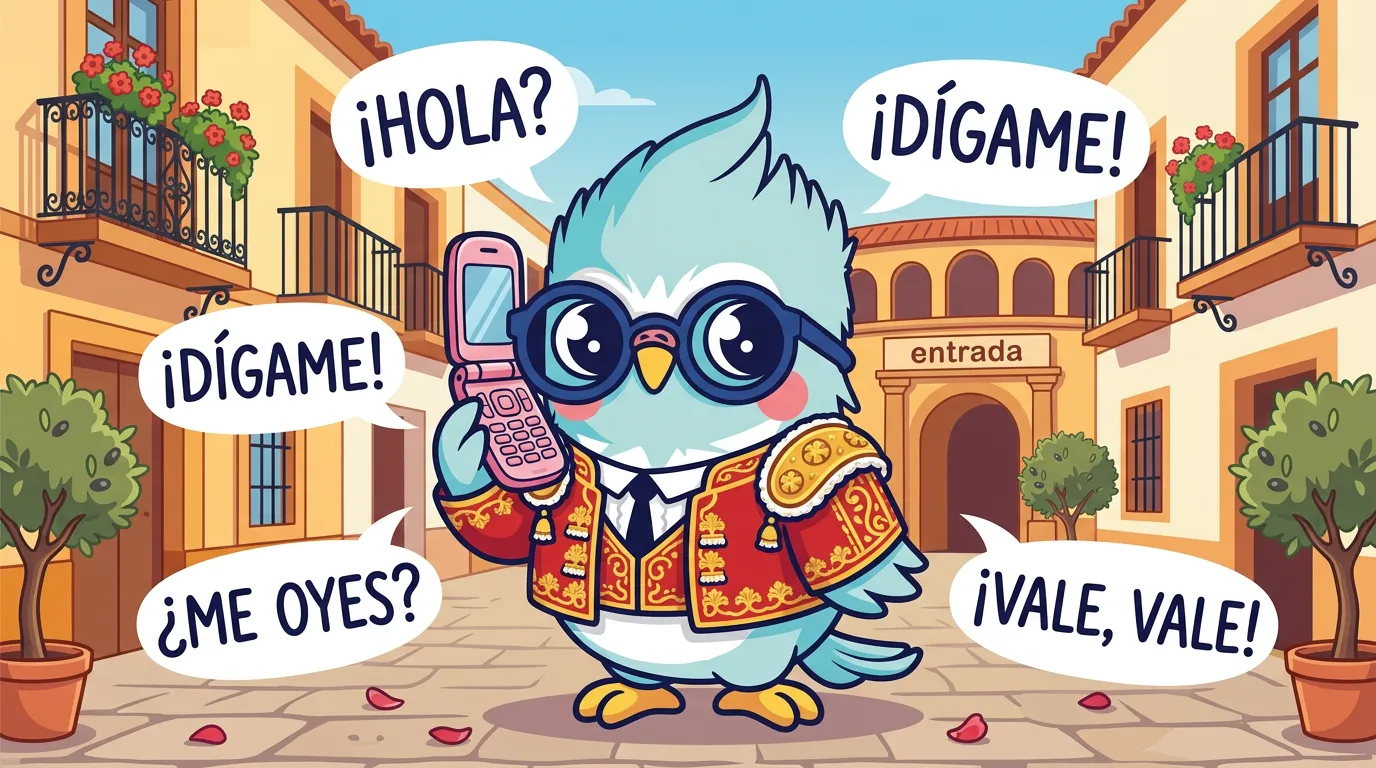
Talking on the phone in Spanish is one of the situations where having the exact phrase ready makes all the difference. This guide is organised by situation so you can find what you need fast and go into every call prepared. If you are regularly calling in a work context, the business Spanish vocabulary guide is a useful companion for the professional terms you will encounter. When you want to practise these conversations aloud in a realistic setting, try pronunciation practice and guided roleplay sessions with Kippy.
How to Start a Phone Call in Spanish
The opening of a Spanish phone call is brief and follows a clear pattern. Most calls begin with a greeting, an immediate introduction and the reason for calling — all in the first few seconds. Unlike in-person conversations, there is no time to ease in gradually. Spanish speakers expect you to identify yourself and state your purpose early, which is why having these opening lines ready is so important. The phrases below cover casual calls with friends and formal calls with businesses or colleagues.
Hello, who is speaking?
Hello, this is Carlos.
Good morning, I’m calling with a question.
Good afternoon, this is Ana from Rivera Company.
I am calling because I have a question about my order.
I am calling to talk about the project.
Asking to Speak With Someone on the Phone
When calling an office, a business or any number where the person you want is not the one who picks up, you need to ask to be connected. The phrase ¿Puedo hablar con…? is the standard way to do this and works in every context. For more formal situations, ¿Está disponible…? signals that you respect the other person’s schedule. The response you get will typically be either un momento, por favor (one moment, please) — meaning you are being transferred — or a explanation of why the person is unavailable, which is when message-leaving phrases become relevant.
Can I speak with Maria, please?
Is the manager available?
Is Juan in the office?
One moment, please.
I will transfer the call to them.
He/she is not available right now. Would you like to hold?
Can you call back later? He/she is in a meeting.
Keeping the Conversation Clear
Asking someone to slow down, repeat themselves or speak up is not rude — it is expected and completely normal on phone calls, even between native speakers. On a bad connection or when a caller speaks quickly, these clarification phrases are essential. Use them confidently rather than nodding along and hoping you understood. If a specific word or term catches you off guard, the instant translation tool lets you verify it quickly without breaking the conversation. Getting the details right is more important than avoiding a brief moment of awkwardness.
Could you repeat that, please?
I didn’t hear clearly.
Can you speak a little more slowly?
Can you repeat your name, please?
I’m sorry, I didn’t understand well. Can you repeat it?
Can you spell that, please?
Asking for Phone Numbers in Spanish
Exchanging numbers during a call requires more care than doing so in person because you only have the spoken word to work from. When giving or receiving a phone number in Spanish, say each digit individually and slowly — if you are not yet confident with Spanish numbers, the Spanish numbers guide covers them thoroughly before you apply them in a call context. After the other person gives their number, repeat it back immediately to confirm. This is standard practice in Spanish-speaking business contexts and avoids errors that are frustrating to correct later over the phone.
What is your phone number?
Can you give me your number?
My number is 555-1234.
Can you repeat the number, please?
What is your contact number? (formal)
So your number is… correct?
Leaving or Taking a Message
When the person you are calling is unavailable, the conversation shifts to message-taking — and this happens fast. The receptionist or colleague will usually ask ¿Desea dejar un mensaje? straightaway. Having a clear answer ready — your name, the reason you called and whether you want a callback — keeps things efficient and professional. If you are the one taking the message, confirm the caller’s name and number before ending the call.
Would you like to leave a message?
I will take a message for her.
I will tell him/her you called.
Can you ask him/her to call me back when they can?
Tell him/her that Juan García from the sales department called.
I’ll leave my number just in case they need to reach me.
Handling Common Phone Situations in Spanish
Beyond the standard flow of a call, a handful of specific situations come up repeatedly. A poor connection, the need to reschedule a call, or confirming details before hanging up — each of these requires a slightly different set of phrases. The sections below give you exactly what to say in each case.
When the Line Is Bad
A dropped signal or a noisy line is one of the most stressful moments on a call because you have to quickly signal that communication is breaking down without letting the conversation fall apart entirely. These are the phrases to use as soon as you notice the problem — do not wait until the connection has deteriorated completely.
I can’t hear you well.
The connection is not very good.
The call is breaking up.
Can you hear me well?
When You Need to Call Back
If a call comes at a bad time or gets cut off, these phrases let you close the conversation cleanly and set up a time to speak again. Being direct and specific about when you will call back is considered more polite than leaving it vague.
I’ll call you later.
Can we talk later?
I can’t talk right now. I’ll call you in an hour.
I will return the call in five minutes.
When You Want to Confirm Information
Confirming details before ending a call avoids misunderstandings that are harder to fix later. In Spanish business contexts, restating key information — a time, a date, a number — signals professionalism and shows you were paying attention. Use these phrases in the final stage of any call where specific information was exchanged.
I just want to confirm the information.
So the meeting is tomorrow at ten.
I just wanted to confirm some details before hanging up.
Are we agreed on that, then?
Ending a Phone Call in Spanish
A call that ends well leaves both parties with a clear sense of what was agreed and a positive impression. In Spanish-speaking professional and personal contexts, a rushed or abrupt ending is considered impolite. The standard closing combines a thank-you with a forward-looking phrase — talk soon, have a good day, goodbye — and takes less than ten seconds. Make it a habit to close every call this way regardless of how brief the conversation was.
Thank you for calling.
Thank you for your time.
Talk soon.
Have a nice day.
Goodbye, see you later.
It was a pleasure speaking with you.
Don’t hesitate to call if you need anything else.
Example Spanish Phone Conversations
The two dialogues below show how these phrases work together in a complete call. Read through them from start to finish so the structure feels familiar before you practise them aloud.
Example 1: Calling a Friend
Hello, who is speaking?
Hello, this is Laura.
Hi Laura, how are you?
Very well, thanks. I’m calling to confirm about tomorrow.
Perfect. So we meet at six.
Example 2: Calling a Business
Good morning, can I speak with the manager?
One moment, please. He is busy at the moment.
Would you like to leave a message?
Yes, please. Tell him that Juan García called.
Of course. Would you like to leave your contact number?
Yes, my number is 555-1234.
Tips for Talking on the Phone in Spanish
A few practical habits will make every call feel easier. Speak at a steady, moderate pace — slower than you think you need to, especially when giving numbers or names. If you miss something, use ¿Puede repetir eso, por favor? without hesitation; native speakers do this too, and it is far better than guessing and having to correct a mistake later. When you need to buy a moment to think or find information, use un momento rather than going silent — silence on a phone call is ambiguous and can make the other person think the connection dropped. Before ending any call where specific details were discussed, confirm them out loud — date, time, number, next step — so both parties leave with the same understanding. To build confidence across a wider range of real phone situations, try real-life scenarios with Kippy, or go deeper with guided roleplay sessions .
Quick Spanish Phone Conversation Phrases
Keep these phrases close for the moments in a call when you need the right sentence fast. Save the ones you use most often in your personal phrasebook so they are ready before any call.
Starting a call
Hello, who is speaking?
Asking for someone
Can I speak with…?
Asking for clarification
Could you repeat that, please?
When the line is bad
I can’t hear you well.
Leaving a message
Can you ask him/her to call me back?
Confirming details
I just want to confirm the information.
Ending the call
Thank you for calling. Have a good day.
Frequently Asked Questions
How do you say 'talk on the phone' in Spanish?
The standard phrase is hablar por teléfono. You will also hear estar al teléfono (to be on the phone) when describing someone who is already on a call, and llamar por teléfono (to call by phone) when referring to the act of making a call.
How do you ask 'What is your phone number?' in Spanish?
The most natural phrase is ¿Cuál es tu número de teléfono? For a formal context, use ¿Cuál es su número de teléfono? You can also say ¿Me das tu número? for a quicker, more casual version when speaking with someone you already know.
What are common phrases used during a Spanish phone call?
The most frequently used phrases are Hola, ¿quién habla? to open, ¿Puedo hablar con…? to ask for someone, Un momento, por favor when putting someone on hold, ¿Puede repetir eso? to ask for clarification, and Gracias por llamar to close the call.
How do you say 'phone call' in Spanish?
The standard word is llamada, short for llamada telefónica. Hacer una llamada means to make a call, recibir una llamada means to receive a call, and devolver la llamada means to return a call.